Showing posts with label Collaborative Research. Show all posts

Friday, September 4, 2026

This Year's Messy Question: 2026-2027


 "Whether you think you can or think you can’t—you’re right.”

-Henry Ford


As you watch your child walk into school, some for the first time, your memory drifts back to the days when they relied on the warmth of your embrace for mobility. Then they began to roll and scoot and pull themselves up on any nearby furniture.


Do you remember the enthusiasm you met them with? Kneeling nearby, arms outstretched, grinning from ear to ear, saying, Come to me.


Were you discouraged by the inevitable tumble as they approached their first steps? Of course not. We expect them to fall. We don’t even view those tumbles as mistakes. That is just how learning happens.


Somehow, we lose sight of this over the years. We forget that mistakes are an essential part of learning. As we age, many of us begin to veer away from trying new things or taking on challenges. Why?


Many of us have internalized the belief that mistakes make us less somehow. Many of us have also had ample experiences where our mistakes were penalized rather than seen as part of learning. By the time we leave high school, we may have already equated mistakes with failure.


But nothing could be farther from the truth. And it turns out that knowing mistakes are necessary makes a world of difference.


When we believe intelligence and skills are malleable rather than fixed, we respond differently to mistakes. In fact, the belief that we can learn from a mistake actually predicts how much we improve after making one. How much we learn.


What if, then, we could help children stay curious about mistakes rather than afraid of them? In other words, what can mistake-making teach us about staying in a relationship with possibility?


Those questions will be guiding our work in the Studio this year.


Join us as we embrace the steps and tumbles that cultivate intrinsic motivation, resilience, grit, curiosity, and a mindset of possibility.


I look forward to another wonderful year as we explore this question together.


“I have not failed. I've just found 10,000 ways that won't work.”

-Thomas Edison

Tuesday, October 21, 2025

Collaboration: The Magic That Connects Us All

Have you ever noticed how a single spark can light up an entire room? That’s what happens when children come together to collaborate. Like tiny puzzle pieces, they fit and flow, creating something greater than the sum of their individual selves.


In the world of early childhood, collaboration is not just about sharing art supplies,. It’s about weaving hearts and minds into a vibrant tapestry of learning. When little ones work together—they’re building connections that grow their brains and their empathy.


Every time a child collaborates, they nurture their understanding of others, their emotional awareness, and their ability to solve problems with kindness. It’s a bit like magic—each shared smile, each problem solved together, creates pathways of connection that last a lifetime.


Collaboration isn’t only for children. When families and communities come together, we create a space for empathy to blossom. Just like the roots of a tree intertwining underground, we support each other’s growth—planting seeds of kindness, understanding, and unity.


At school, we have lots of opportunities to collaborate! This year, we have book studies, photograph exploration, community connections and so much more . Stay on the lookout for opportunities to participate if you’re interested. Together, we can encourage those sparks of wonder to light up, one connection at a time.


Stay curious and full of wonder,

Angelina

Saturday, November 23, 2019

Stone Soup, Grandparents/Special Friends Day and Gratitude

What a full week I have to share with you!  A week overflowing with collaborations and celebrations!
First off, our executive director and resident story teller extraordinaire, Bekke, told the story of Stone Soup to the children.  If you don't know the story there are lots of online resources but none compares to Bekke's (she put a Lakota Sioux spin on hers, weaving native traditions into the traditionally European tale).  Here is a  link to a simple one I found this morning.  Stone soup is a perfect story for Thanksgiving too!  (In case you get inspired to share).
The children were so captivated by the story that they asked to make stone soup in the studio.  Not yet having any ingredients to offer, I asked how they might make it with the materials available.
In a blink the children collected supplies and set to work, drawing, coloring and cutting their contributions before adding them to the soup.
On Thursday we made the real thing.  The children carefully cut all the vegetables into small, bite sized pieces to share with their loved ones on Grandparents and Special Friends Day.
Rhiannon joined me to make dozens of delicious gluten-free corn muffins to add to the festivities.
And BJ spent a day with me, stringing sliced fruits to make garlands that will dry and adorn the studio in the months ahead.
 On Friday we set the bounty on display and opened our doors to greet family and friends.
The atmosphere was enthusiastic!
Throughout the day the children and their friends wrote their gratitudes on brown paper to be added to the Love Tree and dished up their culinary creations.
It was certainly a week to be grateful for!
I am wishing you a wonderful holiday filled with gratitude and thanksgiving, may your days be lit with wonder and your moments bright with curiosity.
See you in December!

Here's a little clip of Bekke's story to get a taste of the tale:

Friday, November 8, 2019

Cloud Study

 Michelle led a wonderful assembly on clouds.
 As a demonstration she used water, shaving cream and food coloring to demonstrate how a cloud fills with moisture, resulting in rain.
 Next, she did an awesome experiment using hot water, a match and ice to create a cloud in a jar!
 The children were enthralled as were all the teachers!
The children communicated their observations in the studio and classroom with creative materials.
And the silver lining of every rainy day is the possibility of a rainbow!

Thursday, October 10, 2019

Collaborative Research: Peace Education

I'm excited about another studio/classroom collaboration that is happening this year! Our Ward-Hobbs morning teacher, Claire, has been interested in Peace Education for a long time.  We've decided to begin intentionally documenting how we promote and practice peace in the school.   This study will allow us to deepen our practice and understanding of peace education.  I will be posting about our collaboration throughout the year, so all of you can join our exploration.
To guide our inquiry, we generated a primary research questions.
How can we as teachers of young children promote peace?
And then broke that down into a few supporting questions to further clarify our research:
  • How do we model peace in the classroom? 
  • How do our movements, words, tone and the lessons we give promote non-violent conflict resolution and mindfulness?
  • How do we demonstrate respect for each child and support them in recognizing and welcoming others as individuals within a group?
  • How do we recognize and nurture signs of empathy and care as they arise?
  • How might we model positive self-talk in a school environment and how might that benefit the children in our care?
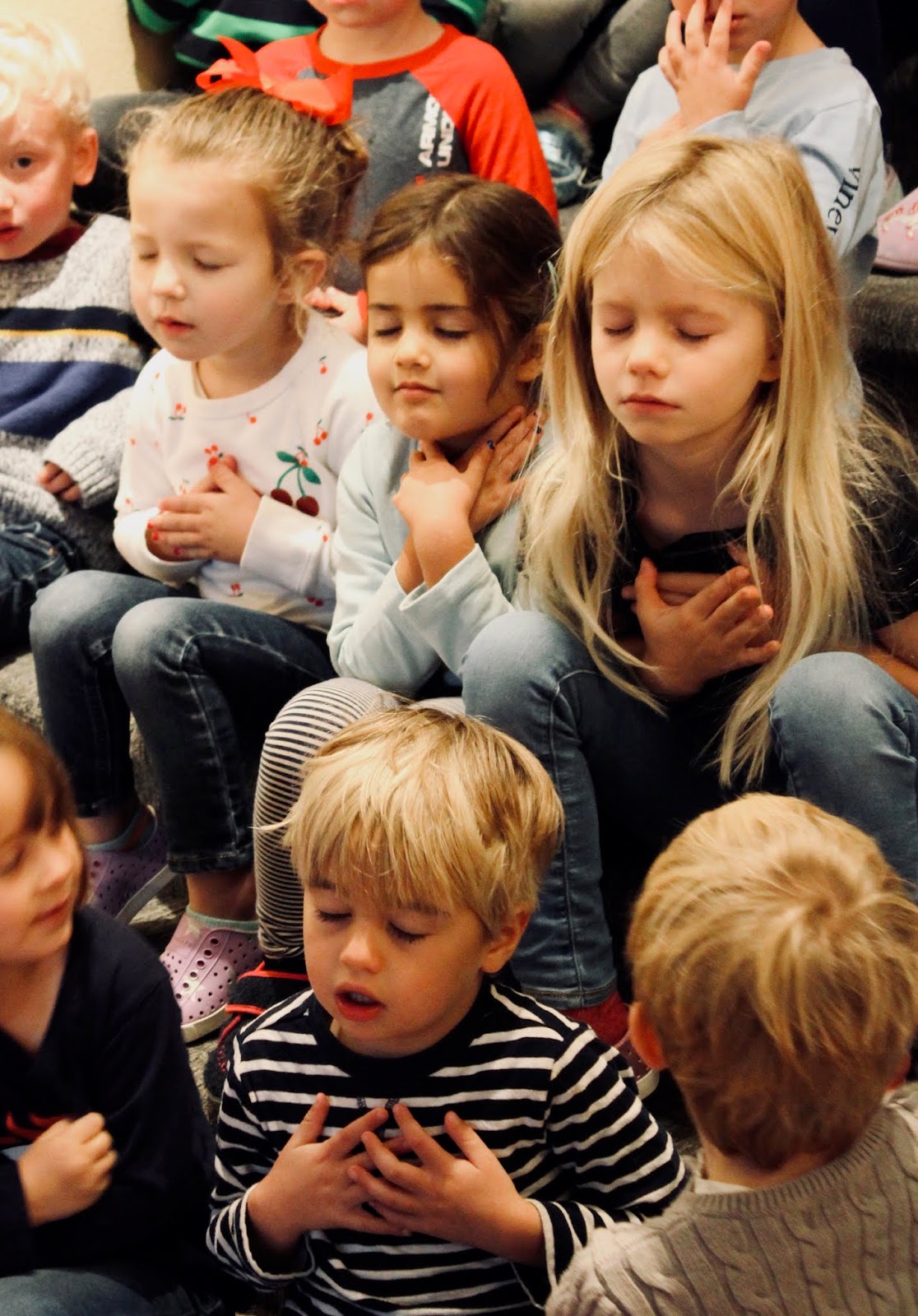
Today Claire offered a Peace Assembly for the morning primary classes.  She began with a few deep breaths and a listening exercise with the singing bowl.
Next she invited the children to share what Peace means to them?
  • Making friends
  • Peace and quiet
  • Being Kind
  • Being friendly to your friends
  • Making friends with others
  • Loving people
  • Hiking in the mountains and having a good time
  • Being nice
  • Having fun
  • Being quiet
  • Being glad
  • Sharing
  • When you like to give people hugs
  • Hugs
  • Kisses
  • Love

Claire read the book, The Peace Book by Todd Parr.
And ended practicing Silence as a group.

Monday, October 7, 2019

Collaborative Research: Redefining Public

The phone rings.  I answer.  My colleague Vida replies enthusiastically, "Angelina I have this question and I want to talk to you about it before I forget!"  
As educators working and learning alongside young children we regularly contemplate questions, interests and concerns any time, day or night.  I welcomed her call!
Vida continued, "Could a broader understanding of community compel us toward more sustainable practice and public policy?" 
Our conversation quickly became animated, fanned by our commitment toward sustainability in practice and education. We didn't have any tidy answers but we were committed to the questions so we decided to collaborate in a year of research to find out more. We discussed thoughts and ideas over several days before settling on a few questions to guide our inquiry.
  1. What responsibility do we have to the public (community we have not seen)? 
  2. What do we mean by "public"? (Keeping in mind that animals... including humans... make up a very small percentage of the biomass on our planet.)
  3. How might we create a shared understanding of public that includes our global biomass and all things that support life?
  4. How do these questions inform our classroom environments, lessons and explorations alongside children.
Formulating queries was the easy part.  Now, how to investigate them?  After some consideration we decided to simply keep doing what we do while paying close attention to how we do it.  We both agreed to track the children's responses and share our observations over the year.
And so it began:
The classrooms are investigating plants this year.  Today, Vida did a beautiful presentation during line time on the symbiotic relationship between plants and animals.  In simplest terms, she demonstrated that when we breathe, we inhale oxygen made by plants as a byproduct of photosynthesis and when we exhale those same plants can uptake the carbon in our carbon dioxide to make the sugars they need to grow. (Of course the process is a tad more complex).  Inhale, exhale. Symbiosis.  This simple lesson communicates interconnection.  Plants and animals need each other for MANY reasons and breathing is not the least among them.  Are they part of our community?
This lesson has support in a variety of classrooms materials, from various plant puzzles, books, classification cards to the various types of plants living and "breathing" in the room (so to speak).
The studio offers other opportunities to explore these concepts.  We can express these ideas in sculpture:
 photography:
 paint:
and more.  Keep checking the blog to follow our year of inquiry.  And feel free to let us know if you have any thoughts, ideas or suggestions.  You can post a comment here, send an email or schedule a time to chat.  Your input is most welcome. 

Friday, September 20, 2019

What will it become?

 "What kind of flower do you think these bulbs will become if we plant them in the ground?"
I asked the children on Tuesday afternoon and the children had fun considering the options... " a tree", "a tulip", "a daisy", "a rose".
They recorded their hypothesis with markers and paper.  These drawings will be revisited in the Spring once the bulbs are grown.  
Planting was wonderful! 
The children worked, quiet and deliberate, kneeling in the dirt, carefully laying two bulbs in a hole and coving them with soil.  When I asked the children to tell me what their bulb might need to grow.  Some answered "water, air and soil", clearly schooled in the science of gardening but others suggested that the bulbs would need happiness, love, mama's and families in order to grow, illustrating their experience that human growth involves more than food, water and shelter. 
Their names and thoughts were recorded on wooden sticks to accompany the bulb through the winter.
And we are looking forward to the spring when our bulbs will push forth in new life, proclaiming their color and petals for all the world to see.  We will share or predictions and results then.