Friday, September 20, 2019
What will it become?
I asked the children on Tuesday afternoon and the children had fun considering the options... " a tree", "a tulip", "a daisy", "a rose".
They recorded their hypothesis with markers and paper. These drawings will be revisited in the Spring once the bulbs are grown.
Planting was wonderful!
The children worked, quiet and deliberate, kneeling in the dirt, carefully laying two bulbs in a hole and coving them with soil. When I asked the children to tell me what their bulb might need to grow. Some answered "water, air and soil", clearly schooled in the science of gardening but others suggested that the bulbs would need happiness, love, mama's and families in order to grow, illustrating their experience that human growth involves more than food, water and shelter.
Their names and thoughts were recorded on wooden sticks to accompany the bulb through the winter.And we are looking forward to the spring when our bulbs will push forth in new life, proclaiming their color and petals for all the world to see. We will share or predictions and results then.
Friday, September 13, 2019
Light and dark as elements of art
Light and shadow are essential elements in art.
Of course we know that shadows are caused when a light beam runs into an opaque object and can't pass through but children don't necessarily know that AND let's face it, explaining things rather than discovering them is a droll way to learn anything. Explanations often fail to convey the shadowy beauty all around us on a sunny day while art attempts to communicate the beauty and mystery of our experience in new and sometimes surprising ways.
Similarly, the toddlers began looking at light and shadow with the help of our light projector and the wonder in the room was palpable.
Of course we know that shadows are caused when a light beam runs into an opaque object and can't pass through but children don't necessarily know that AND let's face it, explaining things rather than discovering them is a droll way to learn anything. Explanations often fail to convey the shadowy beauty all around us on a sunny day while art attempts to communicate the beauty and mystery of our experience in new and sometimes surprising ways.
Currently the studio has both direct and indirect introductions to light and shadow. Together we look at the evidence of light and shadow around us and are beginning to communicate these observations in graphite, chalk, charcoal, ink, water and more. Here are a few examples.
You can join us by looking at the shadows in your day and how light and dark contribute to the experience of beauty in the world around you. When you notice something, take a moment, however brief, to breathe it in and then share it with your child.
Have fun and we'll see you back next week!Friday, September 6, 2019
Structure and Freedom: risk taking and the art of not knowing
The school day begins. Children enter the gate, peek through
the round window, bid a final farewell and walk into school. There
are a few tears. There are confident
strides and last looks. They are beginning a new school year, meeting new
teachers and peers and leaving the comfort of a familiar summer behind.
In classrooms they discover new things daily, attempting new works, adapting to
social expectations and honing self regulation skills. They sit cross-legged in
a circle, wait in turn to speak and navigate the various routines and spaces of
our school. As adults we often overlook their resilience and courage,
taking for granted how much newness a child encounters daily and how willingly
they do so.
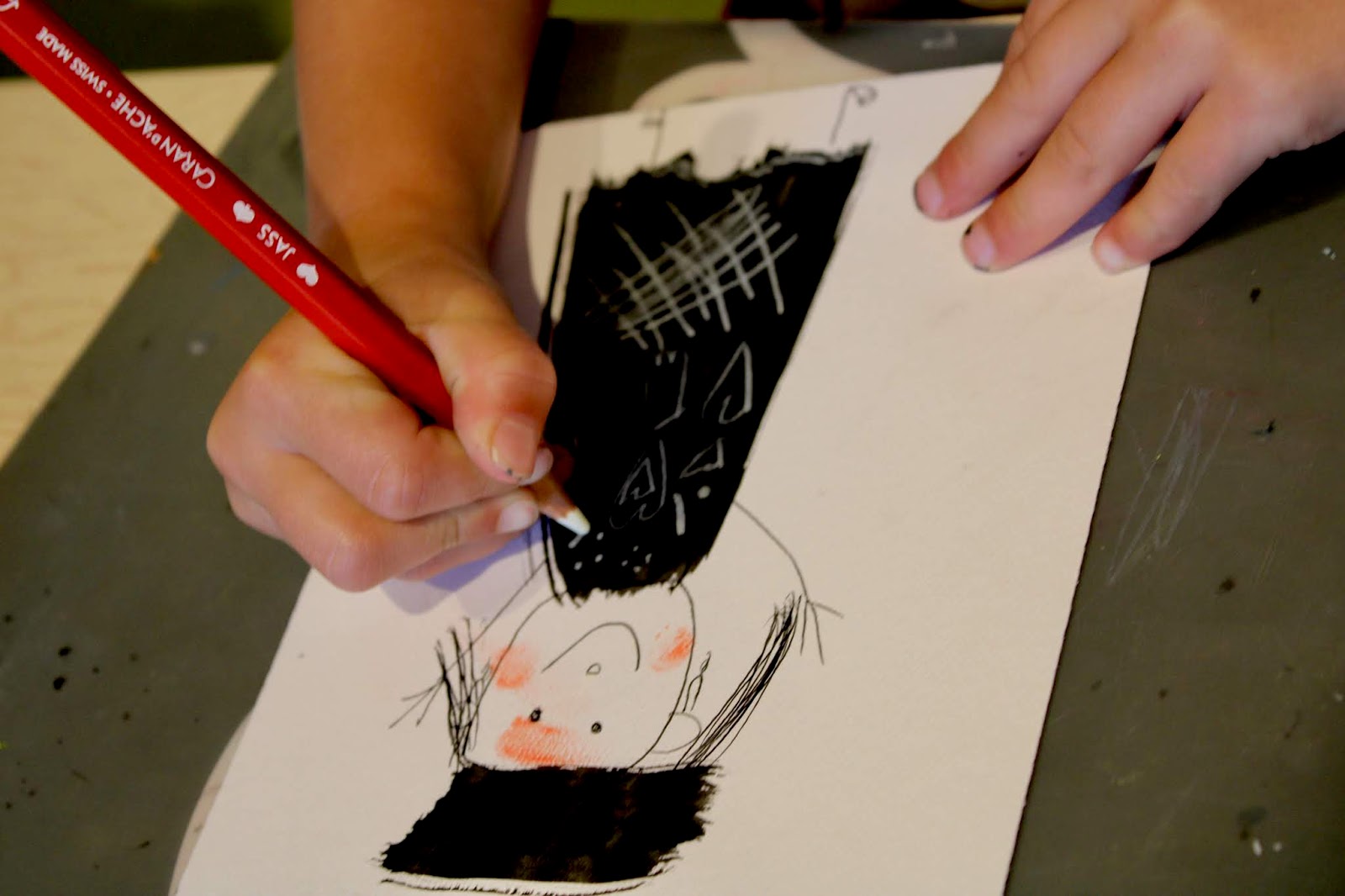
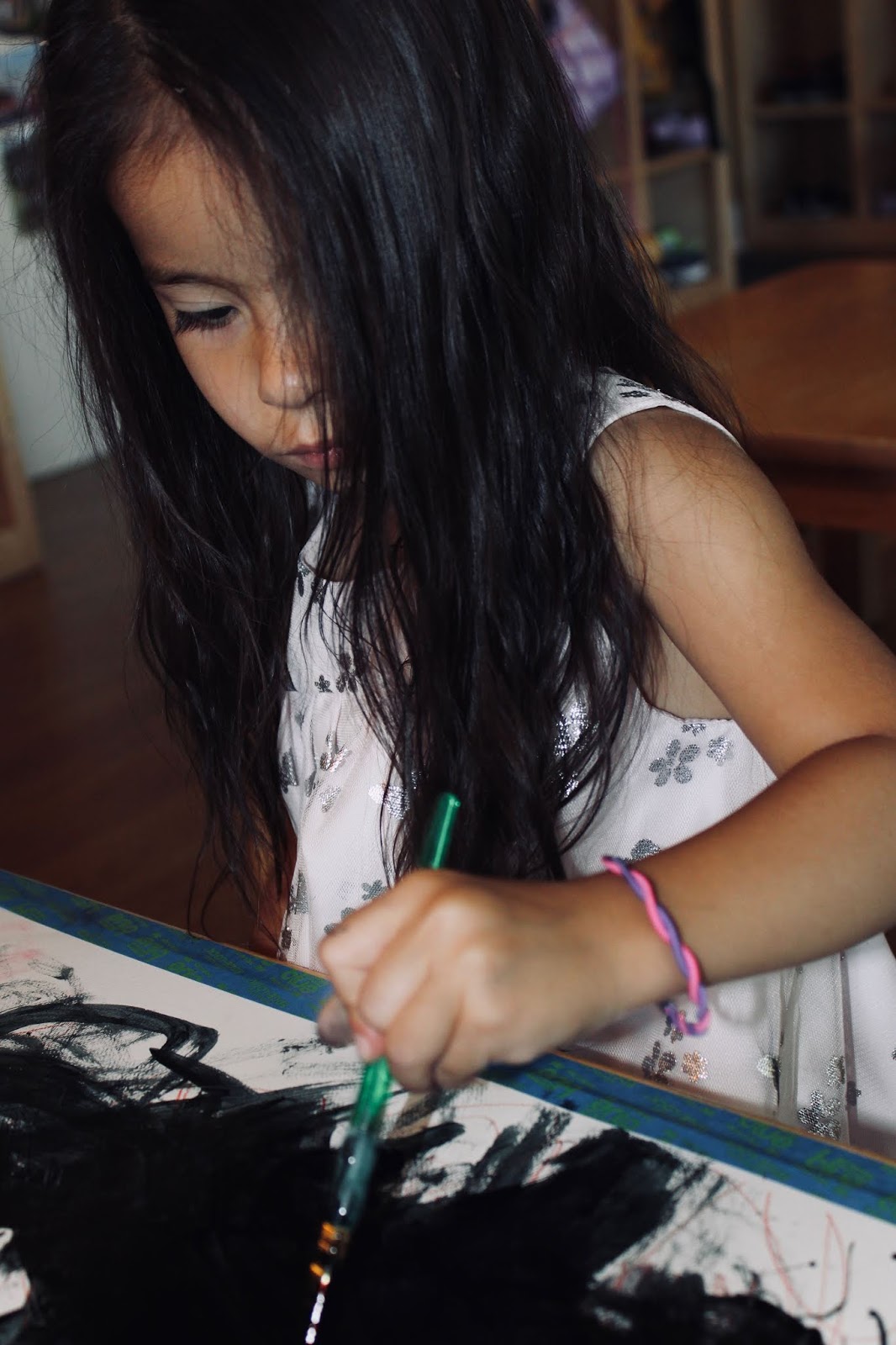
To reproduce a taste of this newness, I set up a provocation for our teachers to participate in. I offered them a wide brush and some sumi ink with which to create the impression of a body and hair using the simplest of brush strokes. Details were added later. As we worked, our discomfort, resistance and vulnerability became obvious. “Will other people judge our work?” “Am I doing this right?” To counter this discomfort some announced, “I’m not good at this” or “I’m not an artist”. For others this activity was well within their comfort zone and they completed it sweat-free. By the next day our work was available for all to see in the school lobby. This week, I invited children to participate in the same activity and wasn’t surprised when they eagerly began to paint. So eager in fact that parameters were harder to maintain. I noticed this. But continued to ask each child to use a simple brushstroke to express the body and another for hair. Art involves structure and freedom. Both are necessary. Children typically embrace the freedom while adults cling to its structure. We need them BOTH.
Children help us rediscover freedom and curiosity. Adults have the ability to mindfully offer a structure to support growth, learning and skill development. It’s a good balance. I look forward to learning and teaching alongside the children this year to discover the joy of not knowing, the power of risk taking and art of making mistakes.
Monday, August 26, 2019
The Big Reveal and the Art of "I DON'T KNOW"
In recent years I’ve noticed an increased tendency on the part of adults to impose learning rather than scaffold discovery. Imposed learning assumes a ready-made foreknowledge of what children need to know and relies heavily on prescribed teaching methodologies to meet said needs. Some of this is necessary and useful but when our focus on test scores outweighs our need to cultivate curiosity, we are off the mark by a long shot. Why?
Young children learn from what we do far more than what we say. How we show up in the “classroom” of our daily experience communicates as much or more than any prescribed learning activity ever could. When we focus on correct answers and established modes of discovery we indirectly discourage mistake making and risk taking. Two things that are essential to creativity, innovation and resilience. Add to this that today's children face an unknown future with challenges prior generations never encountered and we have sufficient cause to pause.
Perhaps the ‘tried and true” methods of teaching, perceiving and approaching the world aren’t sufficient. Perhaps it's time to examine what we don’t know (which, at least for me, is a lot) and recognize how uncomfortable we have have become with not-knowing. Somehow a simple, "I don't know", makes us squirm with embarrassment and implied vulnerability.
But we weren’t always this way.
As young children we delighted in the unknown. We asked questions every chance we got. We marveled as the sun disappeared over the horizon only to magically reappear the next day. At breakfast we tossed our juice cup with scientific rigor over the table’s edge, watching it fall to the floor with a crash-and-bounce. Discovering with gladness a force we would later call gravity. Somewhere along the line we grew up and forgot to be enthralled by the wonders of the world. Here young children have much to teach us! They “don’t know” a lot of the time. And more often than not, they’re cool with it. They wonder and delight. They fall down. They get up. They try and try and try again. This kind of intelligence that has nothing to do with test scores AND everything to do with success.
When we postpone the urge to provide an answer, assistance or advice, we preserve a child's right to discover and in so doing we champion our own.

The school is once again humming with the sound of work and play. Soon the studio will open its proverbial doors and the children will begin exploring!
I couldn't be more eager to welcome them!
Please join me in another year of learning and unlearning alongside your children!
Studio Notes:
- Mark your calendar for our upcoming Studio Orientation on October 10th from 5-7PM. We will have fun discussing share this topic along and sharing important information about the studio.
- If this research question gets you thinking and you might like to collaborate email me at studio@cgmontessori.com
- And as always, I invite you to follow this blog for weekly posts and photos of our year.
Disclaimer: Perhaps as some kind of cosmic joke this particular blog post has insisted on a disparity of fonts, colors and sizes. No effort on my part is countering it and so I am left with a chuckle. Perhaps this is the beginning of my own efforts to embrace mistake making and the many unknowns on the road ahead. Regardless, I apologize for the peculiarity of the script.
Tuesday, June 25, 2019
Art-ing at the Denver Botanic Gardens
I can think of few things I'd rather be doing than exploring nature's artistry and beauty alongside children! Today I visited the Denver Botanic Gardens with several of my young friends. Together we oooh'ed and ahhhh'ed over flowers, art installations and more. Here are a few pics from our day...
This blown glass sculpture by Chihuly inspired the children to practice some observational drawing. The piece was titled, "Colorado, 2014" and we thought the name a bit dry so the children suggested a few more descriptive titles, including: Spike, Porcupine, Porcupine on Fire and Sunbeam.
These two artists were inspired by a gorgeous foxglove growing in one of the Asian gardens.
After some discussion we decided to round out our trip with a visit to the Koi Pond.
It was a wonderful day in the city!
This blown glass sculpture by Chihuly inspired the children to practice some observational drawing. The piece was titled, "Colorado, 2014" and we thought the name a bit dry so the children suggested a few more descriptive titles, including: Spike, Porcupine, Porcupine on Fire and Sunbeam.
These two artists were inspired by a gorgeous foxglove growing in one of the Asian gardens.
After some discussion we decided to round out our trip with a visit to the Koi Pond.
It was a wonderful day in the city!
Subscribe to:
Posts (Atom)