Monday, October 20, 2014

Toddler leaf explorations

"Come little leaves said the wind one day
Come over to the meadow with me to play
Put on your dresses of red and gold
Winter is coming and soon it is cold"
- Autumn Song
The toddlers explored an assortment of fall leaves in the studio on Friday.
As is often the case, object permanence and peek-a-boo was a big point of interest.
The toddlers also did something I wasn't expecting, but their teachers (who have more day to day experience with them nodded knowingly)... they sorted.  They sorted leaves into color categories and they arranged piles of sticks and pinecones.  They discovered that some leaves were dry and crunchy while others were soft and pliable.
Together we learned a lot about the properties of leaves and other seasonal discoveries and the children brought the characteristic joy and enthusiasm of toddlers reminding me to have FUN!

Leaf explorations with wire

To extend the leaf explorations and deepen our conversation I introduced wire, as a tool, to express our ideas about leaf shape, size and more.
 In a short time I realized that something was amiss.
Many of the children were working with wire but it felt forced and there were several comments of: "I can't do this", "Angelina will you do it for me",  "It won't work", etc.  That doesn't actually happen often in the studio.  And then I realized what I had done.  I had introduced a new media (which is a new language) for the first time, with an intentional expectation for it's use.
I know better!  What the children needed was an opportunity to just "mess about" with wire, exploring it's properties and uses before trying to link it with leaf representations.
 Patient as ever, the children still delivered some gorgeous interpretations of leaf and tree.
 And offered me another powerful reminder to SLOW down.

Friday, October 17, 2014

Leaves

Someone recently asked me how I view teaching these days from a Reggio perspective and I answered, research. And research can look like this: first observe the children, second document those observations with photos, video and transcriptions, third reflect on those observations with children, coworkers and families, consult current literature on early childhood and learning as necessary, fourth adapt the environment (laboratory/experiment) to accommodate new understandings, questions and ideas. REPEAT the cycle.

And in the spirit of research, it would be hard to miss that children are naturally interested in seasonal shifts and the colorful cacophony of LEAVES twirling against blue autumn skies.
After spending a week with leaves, I wanted to extend the investigation with the oldest children by bringing in some supported observational drawing opportunities.
The results were beautiful and the children were engaged, focused and busy discovering and communicating the brilliant colors unique to each leaf they selected.
To find out a little more about observational drawing techniques from a past study, click here and here.  Otherwise enjoy some of these images:

Thursday, October 16, 2014

Wonder-full

Wonder is defined by our friends at Merriam-Webster as a "feeling caused by seeing something that is very surprising, beautiful, amazing, etc."  As usual the definition is a bit lack luster in comparison with the experience of WONDER. 
I had the good fortune to join 440AM on their fall walk around the neighborhood this week and wonder was abundant in the hearts, minds and senses of everyone present.
Some of the children discovered the early morning wetness on the grass. Vida bent over the verdant expanse in awe and spoke aloud a number of questions about the wetness. Modeling her own apparent wonder.  Soon J offered that the early morning wet was called dew.  We touched and admired the droplets of glistening water on individual blades of grass and then moved on up the sidewalk.
The trees were colorful conspirators, reminding us of natures expansive palette and her eager willingness to use it.
Another wonder-full exchange happened when bushes were discovered as habitats for tunnel-web spiders.  The oohs and ahhs could be heard for blocks.  Children looked and asked questions.   A few intrepid souls even touched the webs to test tension strength and more.
As adults working and learning alongside children we are all reminded of their natural state of WONDER and the gift that we can meet it with, is our wonder in return.  I hear our teachers, on so many occasions, modeling wonder.  Just this week I heard a teacher talking at length to a group of children about the bird feeder and the seeds that had sprouted and grown into bird feeding stalks, I overheard teachers expressing enthusiasm about worms found on the playground and leaves and seasons and weather and friendship and all the many spenders of life.
On the walk I was fortunate to hold the hand of my friend J, whose wonder was contagious.  I said to him, "J, you bring so much wonder with you on a walk" and he said "YEP! I am a wonder boy".  I said, "Yeah we are full of wonder aren't we".  He smiled up at me with his wide grin and added, "Yeah we are WONDER-full!"
Indeed!

Thursday, October 9, 2014

my best teachers

If you ask the children who is the teacher in the studio, most of them will assure you that they are my best teachers and here is a prime example of why:
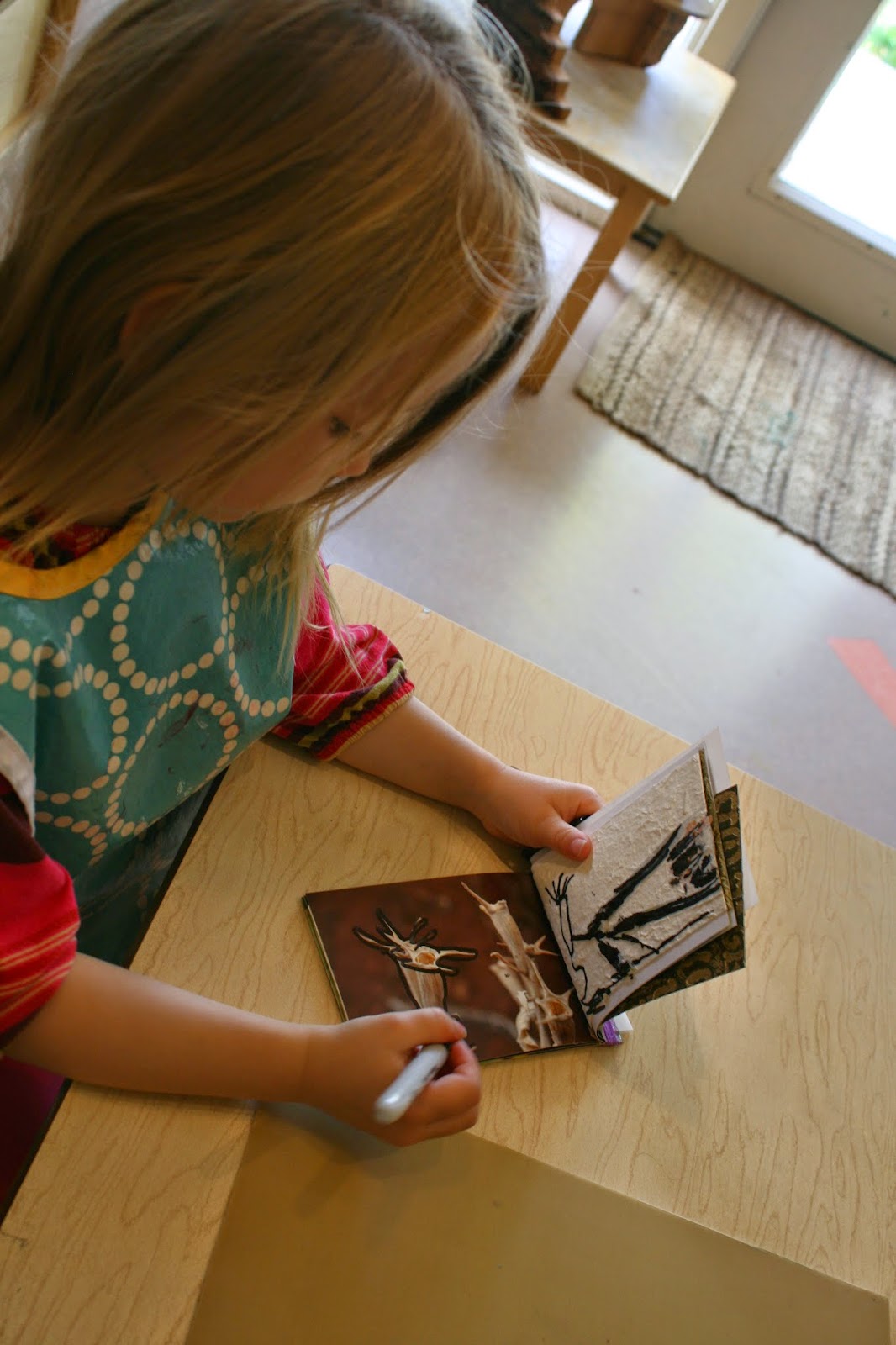
I introduced a stack of nature photographs into the studio to be used in art and as an inspiration for art.  S came into the studio, collected a large bundle of photos, stapled them together and was about to return to class before I said, "Whoa".  I pointed out that taking a whole stack of photos wasn't fair to the other children, I watched her radiant face cloud with regret and immediately realized that I had made a mistake.  I suggested that we look at the stack and decide how we might work with them further.  Her smile brightened again and after some discussion she opted to make a book.
 She spent several studio sessions adding drawings and pages to her book.
When she was finished we read Beautiful Oops! together and I suggested that she could make a book any time.  She quickly countered, "As long as I don't use photos".  I smiled and served myself a big portion of crow and told her that the photo incident wasn't her mistake but mine.  I reminded her that sometimes I think I know how something should be used and then my wonderful teachers come into the studio and remind me of the thousand other ways that I had never begun to imagine.  She laughed at that and returned to her class.

Cognitive knots

A cognitive knot is a problem that impedes progress, just like a knot in a piece of thread halts sewing or a knot in a piece of wood slows the saw.  Cognitive knots can cause frustration and confusion BUT they are also causes for celebration.  They represent what Piaget identified as cognitive disequilibrium, aka learning opportunities.  The Reggio-Emilia philosophies embrace these knots, whether in the form of a conflict of wills, insufficient skills/understanding or just limited theoretical/practical knowledge.  In this tradition of learning, the teachers' responsibility is to recognize these knots as they arise and bring them to the surface, not solve them.  The knots represent wonderful opportunities for social learning, group thinking, skill development and more.
As an example of this, here are some recent observations in the studio.
Block building with ramps has become a very provocative work in the studio. We quickly noticed that the wooden balls speeding down the ramps can create a safety hazard in the studio (knot).  This problem/knot has led to a number of very creative collaborations and solutions:
Some children created vast networks of ramps directed toward the wall instead of the open areas of the classroom to ensure safety.
 Others built elaborate mazes of blocks for the balls to travel through on their descent.
A few children created a counter ramp to slow the progress of the balls and added a long wall to stop the balls altogether.
Others discovered that the momentum of the balls could move the block walls and reinforcement was necessary.
Throughout this process the buildings themselves began to take on greater significance, as ramps (roads) led to castles, sky scrapers, super highways, cities and more.
All of this creativity was in response to a problem/knot...How do we explore ramps while ensuring community safety amidst rolling balls and walking feet?

Monday, October 6, 2014

living and non-living

The children and teachers have been talking about living and non-living in 440.  Rather than focus on abstracts the teachers chose to bring the study to life, literally.
Emily introduced a live bunny to the great joy of the class and together they observed the characteristics and needs of a living rabbit.
Another day, the class spent time observing a stuffed rat and a living rat.  The children offered observations while comparing and contrasting the qualities of the living rat and the stuffed rat.
Emily took great care to write down the traits identified by the children; traits specific to living organisms and non-living organisms while noting the overlapping traits shared by both.

The Colorado Department of Education science standards for preschool specify that children need an understanding that living things have characteristics, basic needs and develop in predictable patterns.  While kindergarten standards specify that children need to understand that organisms can be described and sorted by physical characteristics.  

Interestingly, some approaches to education can focus on standards and overlook how naturally children learn all the time.  This is a gross disservice to the children and learning.  At CGMS I regularly see evidence of the deep respect educators have for how children learn and each child's capacity to do so.  I love watching the children and teachers joyfully researching together.  It inspires wonder, curiosity and respect for the world we inhabit and our attempts to make sense of it.

Friday, October 3, 2014

The value of mess?

A few of the morning toddler parents joined me in the studio this morning and facilitated a painting project with the toddlers for our upcoming annual auction.  They brought in several fun painting tools including: trucks, buses, feathers, scrub brushes, sponges and more and we put them out with a palette of yellows.  Soon a number of our children's feet, legs, hands and even cheeks were brightly adorned with sunny shades of yellow.  A tub of warm soapy water stood at-the-ready as children transitioned from studio back to classroom.   The parents did a beautiful job facilitating the project and the toddlers who participated were animated with smiles, dialog and joyful movement.
I, however, was uncomfortable.
Discomfort as a teacher is always a neon reminder to self reflect.
Why was I uncomfortable? Why?  The answer was simple? It was messy.  That's all really.  Mess seems to be enough to make many adults shudder with discomfort.
Why?
As a Montessori teacher I am trained to support children as they develop a sense of order, concentration, coordination and independence.  As a Reggio inspired educator I am reminded to cultivate collaboration, exploration, innovation and expression.  And so I asked my shuddering adult self, "Is there a value in MESSY?"  I am already familiar with enough of the research supporting sensory play to imagine the answer is likely YES.  Noting my discomfort, I promptly printed several articles on the subject and have already begun talking with the classroom teachers about the topic.  I don't have answers yet but identifying the question is a strong first step.
If you have any ideas or thoughts on the subject, please post a comment here or come by the studio to share with me.  

Interconnected

Your children are always teaching me, reminding me and supporting me as we investigate together the research questions of the year.  As most of you know by now, my primary question has been: How can tools of representation and creative expression be utilized to foster depth connections with the natural world.  The children have already begun to show me that the question itself is flawed by my adult bias toward disconnection.  Adult brains tend to compartmentalize.  It's the nature of our efficient brains.  We see things in separate parts.  Children do not.  For children life remains fluid and although they experiment with abstractions, it is not their primary construct for approaching life in all its complexity.  Over the past weeks I have watched the children form relationships: working together with dramatic play, block building, drawing, painting, investigations and more.  I see these same relationships emerging and developing on: playgrounds, around the snack table, in classrooms and at pick up and drop off. 

As I watched the children working together in this way I wondered how this might relate to the basic research question for the year and then, as is often the humbling case, it occurred to me that perhaps I was beginning from a misconception.  I already see the world as separate and imagine nature and childhood need my help in some way to connect.  The children wordlessly reminded me that, for them, everything is a relationship.  How they relate to the environment, their peers, adults, the breeze, the materials, the weather...everything is an interplay of interconnection.  I will continue to watch them form relationships and build connections and in so doing they will continue to teach me how children learn and remind me how we as adults, might benefit from their wisdom. This insight into interconnection will no doubt inform my future work with the children around seasons, nature, creative expression and belonging.